

Read on to discover how off-plan purchases work in Marbella, which protections your money should have and what could go wrong before you receive the keys.
Why Buyers Are Purchasing Marbella Villas Before Construction Is Complete
Marbella's luxury residential market has attracted considerable interest in contemporary developments, particularly around Nueva Andalucía, the Golden Mile, Benahavís and East Marbella. Purchasing during the early stages of construction allows buyers to select desirable properties before the development reaches completion, sometimes with greater flexibility regarding layouts, interior finishes and available plots.
Developers may also introduce properties at launch prices that differ from the amounts advertised once construction progresses, although buyers should examine whether any proposed discount represents genuine value. Early purchasers accept additional uncertainty concerning delivery dates, construction quality and market conditions. The reward can be an attractive contemporary residence, provided the project reaches completion according to the agreed specifications.
What Does Buying Off-Plan Actually Mean in Spain?
An off-plan purchase involves agreeing to buy a property before construction has finished, sometimes before the first excavation work begins. Buyers generally sign a reservation agreement, proceed to a private purchase contract and pay instalments according to an agreed schedule, with the remaining balance payable at completion.
The developer remains responsible for delivering the residence in accordance with the contractual documentation and applicable construction requirements. Buyers should examine architectural plans, technical specifications and the proposed delivery schedule before committing substantial funds.
Spanish legislation establishes important protections for qualifying advance payments, although the effectiveness of these safeguards depends on the project's legal circumstances and the documentation. Purchasing an architectural promise deserves rather more scrutiny than purchasing a completed villa.
Check the Developer Before You Fall in Love With the Renderings
A developer's financial position and previous construction history deserve examination before any substantial reservation payment. Buyers should establish the company's legal identity, identify its directors and review completed developments, particularly projects with comparable specifications and budgets.
An independent lawyer can investigate the company through relevant Spanish registries and examine whether its previous developments encountered significant delays, contractual disputes or unresolved financial problems. Buyers should also determine whether the project is managed through a dedicated development company, because the commercial reputation of a wider business group does not automatically establish the financial capacity of each subsidiary.
A beautiful showroom can demonstrate excellent interior design skills, but it provides limited information about the developer's ability to finish construction.
The Building Licence: The Document You Should Verify Before Paying

Before committing to an off-plan villa, buyers should establish whether the developer has obtained the appropriate building licence, known as the licencia de obras. The licence confirms that the competent municipal authority has authorised construction under the relevant planning conditions, although it does not guarantee the project's commercial success or eventual completion.
The property's approved architectural plans should correspond with the development presented to purchasers, particularly regarding built area, plot boundaries, height and permitted facilities. Buyers should also investigate whether the developer owns the land or has the necessary legal rights to undertake construction.
Under Spain's advance-payment protection framework, the statutory obligation to guarantee qualifying payments arises when the building licence is granted, which makes the licence's status especially important.
Bank Guarantees: How Spanish Law Protects Your Advance Payments
Spain's Building Regulation Act, Law 38/1999, as amended by Law 20/2015, establishes protections for qualifying advance payments made to residential developers. Once the building licence has been obtained, the developer must secure the return of advance payments through an appropriate bank guarantee or surety insurance policy.
The protection must cover the amounts paid in advance, including applicable taxes and statutory interest calculated according to the legal provisions. Buyers should receive documentation that identifies their protected payments and the financial institution or insurer responsible for the guarantee.
An independent lawyer should verify that the guarantee is properly issued and corresponds to the agreed transaction. At the luxury end of Marbella's market, several instalments can represent hundreds of thousands of euros, making payment protection particularly important.
The Special Bank Account: Where Should Your Deposit Go?
Spanish legislation also requires developers who receive qualifying advance payments to use a special bank account, separate from their other funds, with money allocated to the construction of the relevant residential development. The contract should identify the financial institution and account designated for these payments.
Buyers should verify account details independently before transferring money, particularly when payment instructions arrive by email. Fraudulent changes to bank details can create substantial financial losses, even when the original transaction involves legitimate professionals.
The developer should provide appropriate documentation for each instalment, including the relevant guarantee arrangements. Buyers should be especially cautious about requests to transfer substantial amounts into unrelated accounts or arrangements that have not received independent legal review.
How Payment Schedules Work for Off-Plan Villas in Marbella
Off-plan purchase agreements generally divide the property price into several instalments, with an initial reservation payment followed by contractual deposits, construction-stage payments and the remaining balance at completion. However, Spain does not impose one universal percentage schedule for every residential development.
For illustration, a €2 million villa might involve a €10,000 reservation, further payments that bring the total advance to 30% of the purchase price and the remaining 70% at completion. Some developers link additional instalments to specific construction stages, while others establish contractual payment dates.
Buyers should examine each instalment's due date, the conditions that trigger payment and the applicable guarantee. A payment schedule deserves just as much attention as the architectural floor plans.
A €2 Million Off-Plan Villa: What Could the Payment Schedule Look Like?
A hypothetical luxury villa priced at €2 million provides a practical illustration of the financial commitments buyers may encounter before completion. The following schedule assumes that the purchaser pays 30% of the property price before handover, with the remaining 70% due at the notary appointment.
Payment stage
Percentage
Amount
Reservation
Part of initial 10%
€10,000
Private purchase contract
Balance of initial 10%
€190,000
Construction-stage payment
20%
€400,000
Completion at the notary
70%
€1,400,000
Total purchase price
100%
€2,000,000
The amounts exclude VAT, which generally applies to the corresponding advance payments as they become due. The payment structure is illustrative rather than a standard contractual requirement, and buyers should verify that every qualifying advance enjoys the appropriate statutory protection.
Why the Private Purchase Contract Deserves More Attention Than the Brochure
The private purchase contract establishes the principal obligations between buyer and developer, including the agreed price, payment schedule, property specifications and completion conditions. For an off-plan purchase, the documentation should also identify the applicable guarantee arrangements and the account designated for advance payments.
Architectural plans and the memoria de calidades, a document describing construction materials and technical specifications, deserve particular attention. Buyers should understand which finishes, appliances, exterior features and installations form part of the contractual purchase.
Provisions concerning design alterations, construction delays and cancellation rights should receive independent legal review. An elegant brochure may promise Italian marble and extraordinary terraces, but the signed contractual documents determine what the developer must deliver.
Construction Delays: What Happens If Your Marbella Villa Is Late?
Construction projects can experience delays because of contractor availability, supply problems, technical complications or administrative procedures. Buyers should examine the agreed completion date and any contractual extension provisions before accepting the payment schedule.
Under Spanish consumer protection rules, developers cannot rely on unfair contractual clauses that allow arbitrary or indefinite delays. Depending on the circumstances, buyers may have grounds to demand performance, seek compensation for demonstrable losses or terminate the agreement and recover qualifying advance payments.
Spain's statutory guarantee framework also establishes procedures for recovering protected sums when construction fails to begin or the property is not completed as agreed. Buyers should obtain legal advice promptly when significant delays arise, particularly because guarantee claims are subject to procedural requirements and deadlines.
What Happens If the Developer Goes Bankrupt Before Completion?
Developer insolvency represents one of the most important financial risks associated with off-plan purchases. A project may remain unfinished while creditors, contractors and financial institutions pursue their respective interests, potentially creating substantial uncertainty for buyers who have already made advance payments.
A valid bank guarantee or surety insurance arrangement provides an important mechanism for recovering qualifying protected amounts when the statutory conditions are satisfied. However, buyers should examine the exact guarantee documentation and act within the applicable legal deadlines.
The Bank of Spain explains that protected purchasers can pursue reimbursement through the guarantor when the developer fails to return the amounts within the legally established period following a valid demand. Having independent legal representation becomes particularly valuable if the development enters financial difficulty.
Can You Recover Your Deposit If the Project Never Gets Finished?
Spanish legislation provides mechanisms for buyers to recover qualifying advance payments when construction fails to begin or the residence is not delivered within the contractual framework. The applicable provisions can include recovery of the advance amounts, relevant taxes and statutory interest.
Where the statutory guarantee procedure applies, the buyer generally must formally demand reimbursement from the developer, with a 30-day period for payment before a claim against the guarantor, subject to the legal exceptions. The guarantee also has important time limits, so delayed action can affect recovery rights.
Buyers should distinguish between developer default and a voluntary decision to withdraw from the purchase. Cancellation because the purchaser changes their mind may have very different financial consequences under the signed agreement.
What If the Finished Villa Looks Different From the Original Plans?
A completed off-plan property may contain differences from the architectural presentations used during the original marketing campaign, particularly when developers substitute materials, modify layouts or make technical adjustments during construction.
Some changes may be permitted under the contract or required for legitimate technical reasons, but substantial differences affecting agreed specifications can create disputes. Buyers should compare the finished property with the signed plans and memoria de calidades, particularly regarding interior dimensions, terrace areas, installed equipment and construction finishes.
An independent architect can document discrepancies and assess their significance before completion. The spectacular infinity pool from the original renderings deserves careful comparison with the swimming pool that actually reaches the property.
The First Occupation Licence: Why Completion Requires More Than Finished Construction
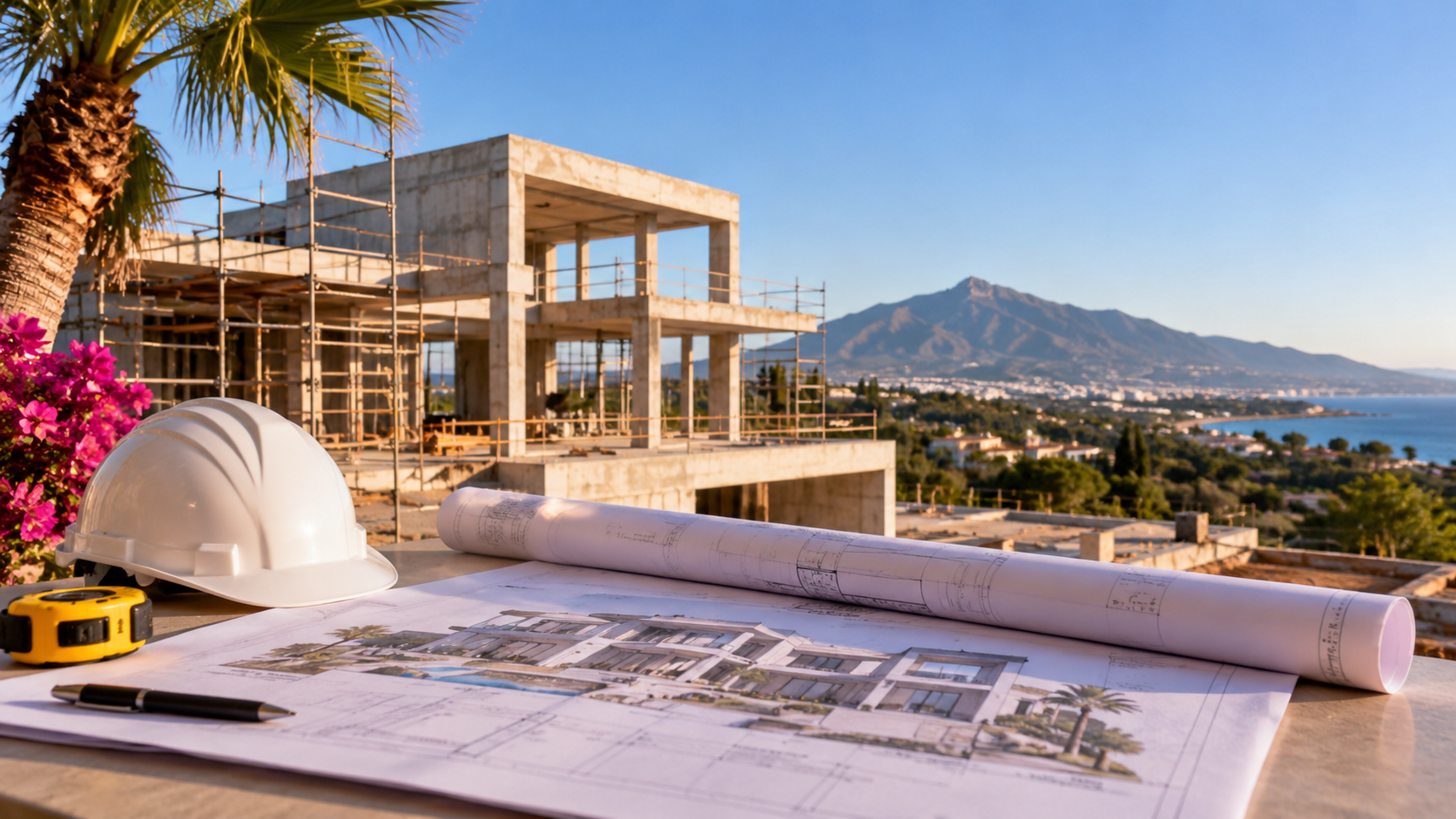
Before completing an off-plan purchase, buyers should investigate the relevant first occupation documentation, commonly associated with the licencia de primera ocupación or an equivalent procedure recognised under applicable Andalusian and municipal rules.
This documentation concerns the legal occupation of the completed residence and the applicable regulatory requirements. Buyers should examine whether the developer has satisfied the necessary conditions before accepting handover, particularly when the property requires final administrative procedures.
The contractual and statutory arrangements concerning advance-payment guarantees also refer to the relevant occupation authorisation or equivalent document and evidence of delivery. A finished villa with landscaped gardens and beautifully arranged furniture may still require important legal verification before the purchase can safely conclude.
Snagging Inspections: What Should You Check Before Accepting the Keys?
A professional inspection of the completed residence can identify defects that deserve attention before or after handover, depending on the contractual arrangements. Buyers should examine doors, windows, flooring, bathrooms, kitchen installations and electrical systems, alongside the operation of heating, cooling and home automation equipment.
Luxury villas also contain technical features that require specialist examination, particularly swimming pools, waterproofed terraces, drainage systems and complex mechanical installations. A written defect list allows the parties to document outstanding issues and establish the appropriate corrective procedures.
Buyers should verify the condition of all areas included in the contract, including garages, storage rooms and outdoor spaces. A flawless marble staircase looks impressive, but properly functioning drainage tends to be more useful during heavy rainfall.
Structural Warranties: What Protections Apply After the Villa Is Finished?
Spain's Building Regulation Act establishes statutory liability periods for qualifying construction defects, with different protections according to the nature of the problem. Structural defects affecting the building's stability can fall within a ten-year liability period, while certain defects affecting habitability are subject to three years.
Defects involving finishing or completion elements generally fall within a one-year liability period under the relevant statutory framework. These periods have specific starting points and legal conditions, while insurance requirements and available remedies depend on the building and transaction.
Buyers should request appropriate construction documentation and warranty details before completion. A newly constructed property deserves an independent technical inspection despite its age, because expensive finishes provide no guarantee that every underlying installation has been executed correctly.
New-Build Taxes: How Much Extra Should Buyers Budget in Andalusia?
An off-plan residential property purchased through a qualifying first supply generally attracts 10% VAT in Spain. Andalusia also applies a general stamp duty rate of 1.2% to qualifying notarial transactions, which increases the total acquisition cost beyond the developer's advertised property price.
For a hypothetical €2 million villa, VAT would amount to €200,000, while stamp duty would add €24,000, subject to the applicable taxable bases and legal conditions. The combined amount reaches €224,000 before legal expenses, registration charges and other transaction costs.
VAT on advance payments generally becomes chargeable as payments are received, according to the relevant tax rules. Buyers should establish how taxes are invoiced at each stage and confirm the total financial commitment before signing.
Off-Plan vs Completed Luxury Villa: Which Is the Better Investment?
Off-plan properties can attract purchasers interested in early-stage pricing, contemporary specifications and the opportunity to select desirable units before completion. However, buyers accept construction uncertainty and may commit substantial capital months or years before they can occupy or rent the residence.
Completed villas allow purchasers to inspect the actual accommodation, surrounding developments and construction quality before completing the transaction. They also eliminate uncertainty concerning the original construction schedule, although existing properties may require renovation or technical improvements.
Investment performance depends on the acquisition price, location, developer quality and eventual market conditions. An attractive launch price can lose its advantage if delays, additional expenses or an excessive valuation reduce the property's financial appeal.
The Warning Signs Buyers Should Investigate Before Reserving
Certain circumstances deserve particular attention before an off-plan purchase proceeds, especially when the project involves substantial advance payments or an unfamiliar developer. Buyers should examine the relationship between the advertised development, the legal documentation and the actual construction status.
Potential warning signs include:
A developer who cannot provide satisfactory evidence of the relevant building licence;
Advance payments requested without appropriate guarantees or documented arrangements for their protection;
Payment instructions involving accounts that differ from those established in the reviewed contract;
Construction specifications that remain excessively vague despite substantial financial commitments;
Contractual provisions that permit broad changes to the property or indefinite delivery extensions;
Unexplained discrepancies between architectural plans, authorised construction and promotional materials.
Each concern deserves independent legal or technical examination before the purchaser commits substantial capital.
How to Buy Off-Plan in Marbella With Greater Financial Confidence
A carefully structured off-plan purchase begins with the developer's legal and financial background, followed by verification of the land title, building permissions and contractual documents. Buyers should engage an independent Spanish property lawyer before making significant payments and arrange technical advice when the development involves unusual architectural or construction characteristics.
The payment schedule should correspond with the agreement, while qualifying advances must have the protections required by Spanish law. Buyers also need to understand the delivery conditions, relevant guarantees and procedures for resolving construction defects.
For international purchasers, financial preparation is particularly important because mortgage arrangements, currency movements and administrative requirements can affect the ability to complete the transaction when the property is ready.
Is Buying Off-Plan in Marbella Worth the Risk in 2026?
Off-plan luxury villas can represent attractive opportunities for buyers interested in contemporary architecture, modern construction specifications and access to desirable new developments in Marbella and the surrounding Costa del Sol. Early purchases may also provide greater choice of plots, orientations and interior configurations.
However, the potential advantages deserve careful comparison with construction delays, developer-related risks and the financial commitment required before completion. Appropriate guarantees, independent legal review and well-drafted contractual conditions are essential for protecting the purchaser's interests.
The strongest off-plan purchase combines a credible developer, desirable location, carefully reviewed payment arrangements and a property price supported by comparable market evidence. A spectacular architectural rendering can start the conversation, but the contract and technical documentation should determine whether the investment deserves your signature.
Interested in purchasing an off-plan luxury villa or exploring new residential developments in Marbella? Discover exclusive real estate opportunities with Stefan Nita and find a property that matches your budget, architectural preferences and long-term plans on the Costa del Sol.